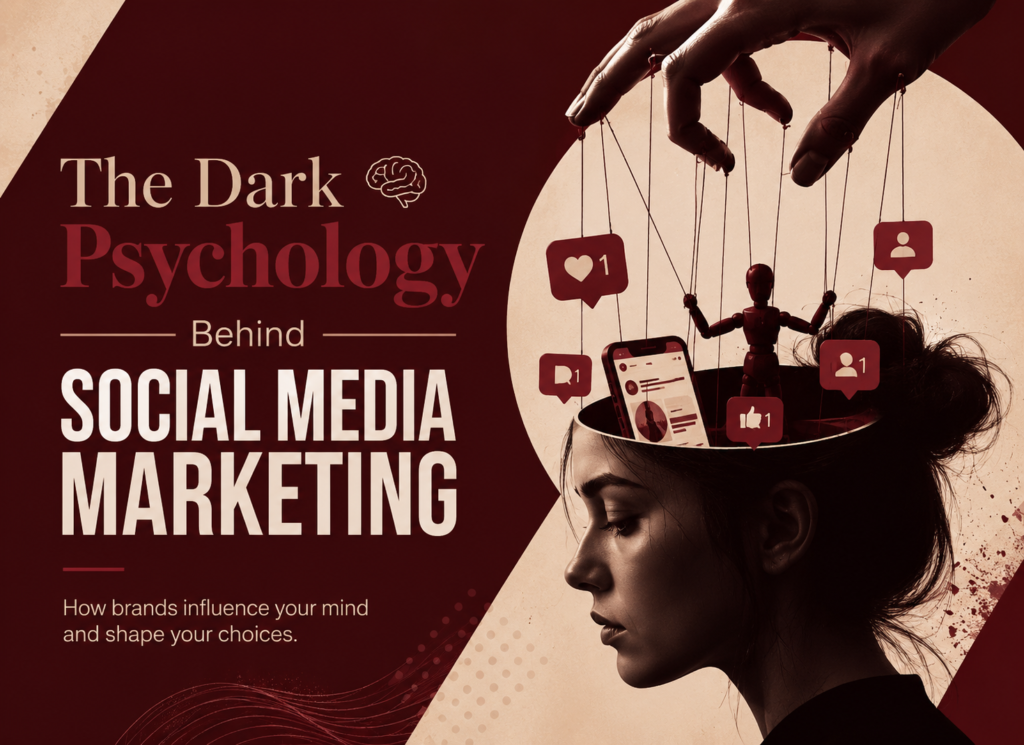
The Dark Psychology Behind Social Media Marketing
Attention: Why Can’t You Put Your Phone Down?
You told yourself you’d check Instagram for five minutes. That was forty minutes ago.
This isn’t a willpower problem. It’s a design problem. Every scroll, every notification ping, every “like” that lights up your screen has been engineered by teams of psychologists, behavioral economists, and UX designers whose sole job is to keep your eyes glued to a feed. And if you’re a marketer, understanding exactly how this works isn’t optional anymore . it’s the difference between content that gets ignored and content that gets obsessed over.
Welcome to the dark psychology of social media marketing: the science of persuasion, habit formation, and subtle manipulation that shapes almost everything you see online. Some of it is ethically gray. All of it is worth understanding because once you see the mechanics, you can’t unsee them, and you can start using them responsibly instead of being used by them.
Interest: The Psychological Triggers Driving Every Scroll
1. The Variable Reward Loop
Slot machines are addictive because you never know when you’ll win. Social media feeds work the same way. You don’t know if your next scroll will reveal a boring post, a hilarious meme, or a life-changing piece of news and that unpredictability is precisely what keeps your thumb moving. This is called a variable ratio reinforcement schedule, and it’s one of the most powerful behavioral conditioning tools ever discovered. Marketers exploit it by mixing predictable content (regular posting schedules) with unpredictable payoffs (surprise giveaways, unexpected reveals, plot-twist storytelling).
2. Social Proof and the Herd Instinct
Humans are wired to look at what others are doing before deciding what to do themselves. That’s why follower counts, like counts, and “10,000+ people bought this” banners work so well. Your brain doesn’t consciously calculate the credibility of a product it just sees a crowd and assumes safety in numbers. Brands manufacture this proof constantly: seeded reviews, influencer endorsements, “as seen on” badges, and testimonial walls all trigger the same ancient survival instinct.
3. FOMO (Fear of Missing Out)
Countdown timers. “Only 3 left in stock.” “Offer ends tonight.” “Join 50,000 others on the waitlist.” These aren’t accidents they’re deliberately engineered urgency cues that exploit loss aversion, our tendency to fear losing something more than we value gaining something equivalent. Scarcity messaging bypasses rational decision-making and triggers an almost primal urgency response.
4. The Dopamine Feedback Loop
Every notification, like, comment, or share triggers a small dopamine release in your brain the same neurochemical involved in reward and habit formation. Platforms are explicitly designed to maximize these micro-hits. Red notification badges (a color chosen for its urgency and alarm associations), auto-play videos, and infinite scroll all exist to prevent your brain from ever reaching a natural stopping point.
5. Reciprocity
When a brand gives you something free ,a downloadable guide, a discount code, a genuinely useful tip you feel a subtle, often unconscious obligation to give something back, whether that’s your email address, a follow, or eventually a purchase. This is the norm of reciprocity, one of the oldest principles in persuasion psychology, and it’s why “free value” content strategies work so well on social media.
6. Anchoring and the Illusion of a Deal
“Was ₹4,999, now ₹1,999.” Even if the original price was inflated or invented, your brain locks onto that first number as a reference point, making the discounted price feel like an unmissable bargain. This is anchoring bias, and it’s used everywhere from Instagram product ads to flash-sale carousels.
7. In-Group Identity and Tribalism
Brands increasingly sell identity, not just products. “Are you a girl-boss?” “Real hustlers know…” “This is for people who get it.” By framing a product or lifestyle as belonging to an exclusive tribe, marketers tap into our deep need for belonging and social identity and turn customers into loyal, almost tribal advocates who defend the brand as if it were part of who they are.
Desire: Why This Matters for You as a Marketer
Here’s the uncomfortable truth: these techniques work because they’re built on real, hardwired aspects of human psychology. Ignoring them doesn’t make you more ethical it just makes your marketing less effective while competitors who understand these levers pull ahead.
The real skill isn’t avoiding psychology. It’s using it responsibly.
There’s a meaningful difference between:
- Using genuine scarcity (“we only made 200 units”) versus fake countdown timers that reset every time someone visits the page
- Showcasing real customer results versus fabricated testimonials
- Creating authentic urgency around a real deadline versus manufacturing panic to force impulse purchases
- Building genuine community versus exploiting tribal instincts to silence criticism of your brand
When you understand why these psychological triggers work, you gain the ability to use them with intention building campaigns that convert without leaving your audience feeling manipulated, regretful, or resentful after the dopamine wears off. That’s the version of “dark psychology” that actually builds long-term brand trust instead of burning it.
This matters more now than ever. Audiences are growing psychologically literate. They’ve read the think-pieces about dopamine loops and manufactured urgency. The brands that will win the next decade of social media aren’t the ones squeezing the last drop out of manipulative tactics they’re the ones who apply psychological insight transparently, creating experiences people genuinely want to engage with rather than feel tricked into.
Action: How to Apply This Ethically, Starting Today
You don’t need to abandon persuasion psychology you need to wield it with a conscience. Here’s where to start:
- Audit your urgency claims. If you’re using countdown timers or “limited stock” messaging, make sure it’s true. Fake scarcity destroys trust the moment it’s discovered.
- Build real social proof. Instead of buying followers or fabricating reviews, invest in genuine user-generated content, authentic testimonials, and community engagement that speaks for itself.
- Design for value, not just addiction. Ask whether your content strategy is genuinely useful and enjoyable, or whether it’s purely optimized to maximize screen time at your audience’s expense.
- Use reciprocity generously. Give real value upfront guides, tools, insights before asking for anything in return. It compounds into loyalty rather than resentment.
- Know your audience’s psychology, not just their demographics. Understanding what drives attention, trust, and action lets you craft messaging that resonates without needing manipulative shortcuts.
Ready to put ethical persuasion psychology to work for your brand? Get in touch and let’s build a social media strategy that converts without the manipulation.